Made-to-measure wooden walk-in wardrobes in Baena
When people talk about a wooden walk-in wardrobe, the word "wood" covers three very different materials: solid wood, natural veneer and wood-effect board. Each behaves differently, costs differently and suits a different part of the wardrobe. In Baena, made-to-measure wooden walk-in wardrobes come down to choosing what you see, what you touch and what stays hidden. This guide will help you put those decisions in order.
Shape your next wardrobe.
Try out the measurements, plan the interior layout and choose your finishes. See your idea take shape and share it with us so we can prepare your quote.
Send us your configuration with your measurements and we'll give you a guide price within 24 hours, free of charge. The measuring visit at your home comes afterwards.
Deciding where you want visible wood
Before getting into species, you need to decide where the material will be on show. In an open walk-in wardrobe, almost everything is visible; in one with doors, the wood that matters is the doors and the edges of the shelves. And inside the drawers, it is rarely worth paying for a premium grain.
In Baena, as anywhere, a good habit is to mark three zones on the plan: what you look at (doors, visible shelves, trim), what you touch (handles, drawer edges, rails) and what stays hidden (rear side panels, backs, drawer interiors). The material is assigned by zone rather than for the whole wardrobe.
That way, a made-to-measure wooden walk-in wardrobe can show real grain where it matters and keep costs reasonable everywhere else.
Solid wood, natural veneer and decorative board
Solid wood is a single whole piece, with no layers. It is sturdy and can be sanded and refinished, but it moves with changes in humidity and is very heavy, so it is kept for specific elements such as small doors, visible shelves or mouldings.
Natural veneer is a very thin sheet cut from a real tree trunk and bonded to a backing that doesn't move. It gives you the authentic grain of oak or walnut with less weight and less risk of warping, and it is the usual choice for large doors.
Wood-effect board has a printed paper or film that imitates the grain. It stands up well to wear and moisture, has a very even tone and is usually the most economical solution for interiors. None is better in the abstract; what matters is that each one is used where it performs best.
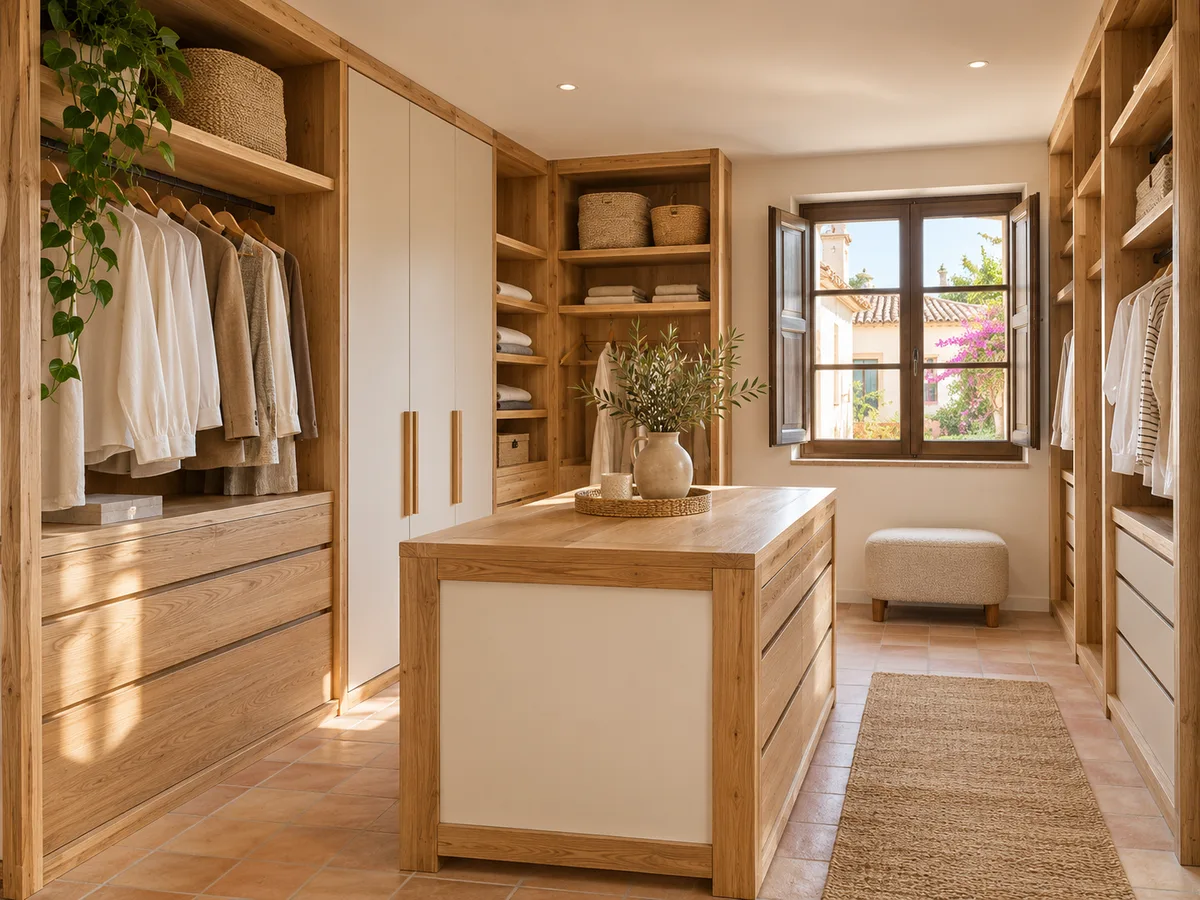
Which material for each type of component
In practice, a walk-in wardrobe is made up of three families of components. The structure (side panels, backs, fixed shelves) carries the weight and is rarely fully visible. The fronts (doors, drawers) are the face of the wardrobe. The accessories (rails, handles, trays) are what you touch most.
The structure almost always uses stable board, because it holds the load best without sagging. The fronts can be veneer or solid wood if you want to feel the material when you open them. And the accessories can be metal, wood or a combination.
It helps if the shelf edging matches the tone of the front. An edge in a different colour gives away the shelf material and breaks the feeling of a single piece.
Have you already measured the space?
Send us a photo and the approximate measurements on WhatsApp and we'll give you some initial guidance.
Tone, grain and physical sample
- 01
A catalogue name isn't enough. A light oak can look almost white in one batch and yellowish in another, and the same tone changes with the varnish. That is why a physical sample is the only reliable guide.
- 02
Take it into the room and look at it at three times of day: in the morning in natural light, at dusk and with the artificial lights on. Check the grain too: horizontal on the shelves and vertical on the doors usually looks tidy, while mixing directions on the same surface draws the eye.
- 03
Strongly marked grain gives character but needs space to show; in a small walk-in wardrobe, softer grains work better because they don't weigh down the look.
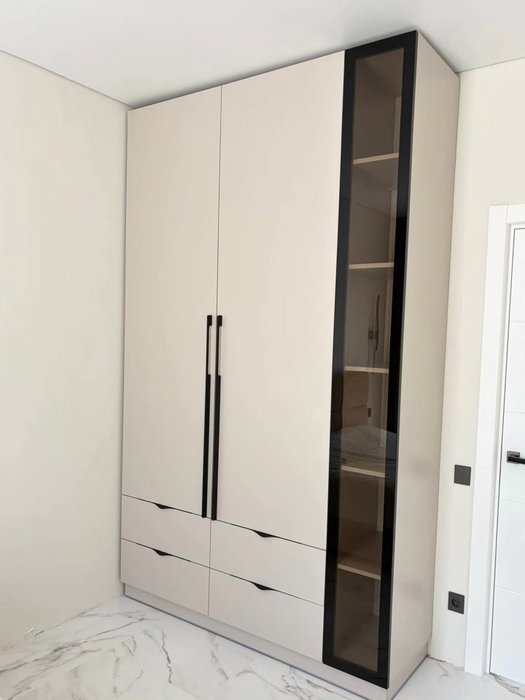
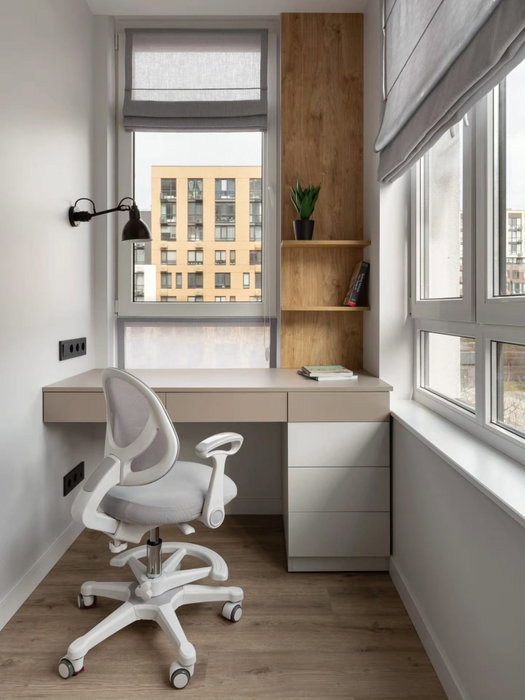
Latest work by SI, ARMARIO
@si.armario
Made-to-measure wardrobes and walk-in wardrobes
Latest posts
Combining wood with other surfaces
A walk-in wardrobe made entirely of wood can feel heavy, especially if it is dark. A lighter option mixes the wood with plain surfaces in white, sand or grey, which let the grain breathe and reduce the visual mass.
Other common combinations are wooden doors with a light-toned interior, which improves the light inside the wardrobe, or wooden frames with glass or mesh panels. Rails and handles in matt black or aged brass add contrast.
The practical rule is for the wood to take up roughly half of the visible surface, with the rest acting as a backdrop. With that balance, the whole looks considered rather than overdone.
Looking after wood over time
Caring for wood isn't the same in all three cases. Solid wood with oil or wax needs touching up from time to time and appreciates a dry cloth. Varnished veneer is cleaned with a damp cloth and copes well with daily use as long as you don't get it too wet.
Wood-effect board is the easiest: it is simple to clean, resists scuffs and needs no treatment. In return, it can't be sanded or repaired like real wood.
There is one more factor: direct sunlight. In a room with a south-facing window, light natural tones tend to lighten and dark ones fade over the years. If the walk-in wardrobe gets sunlight, it is worth choosing a finish with protection and keeping the more delicate garments away from it.
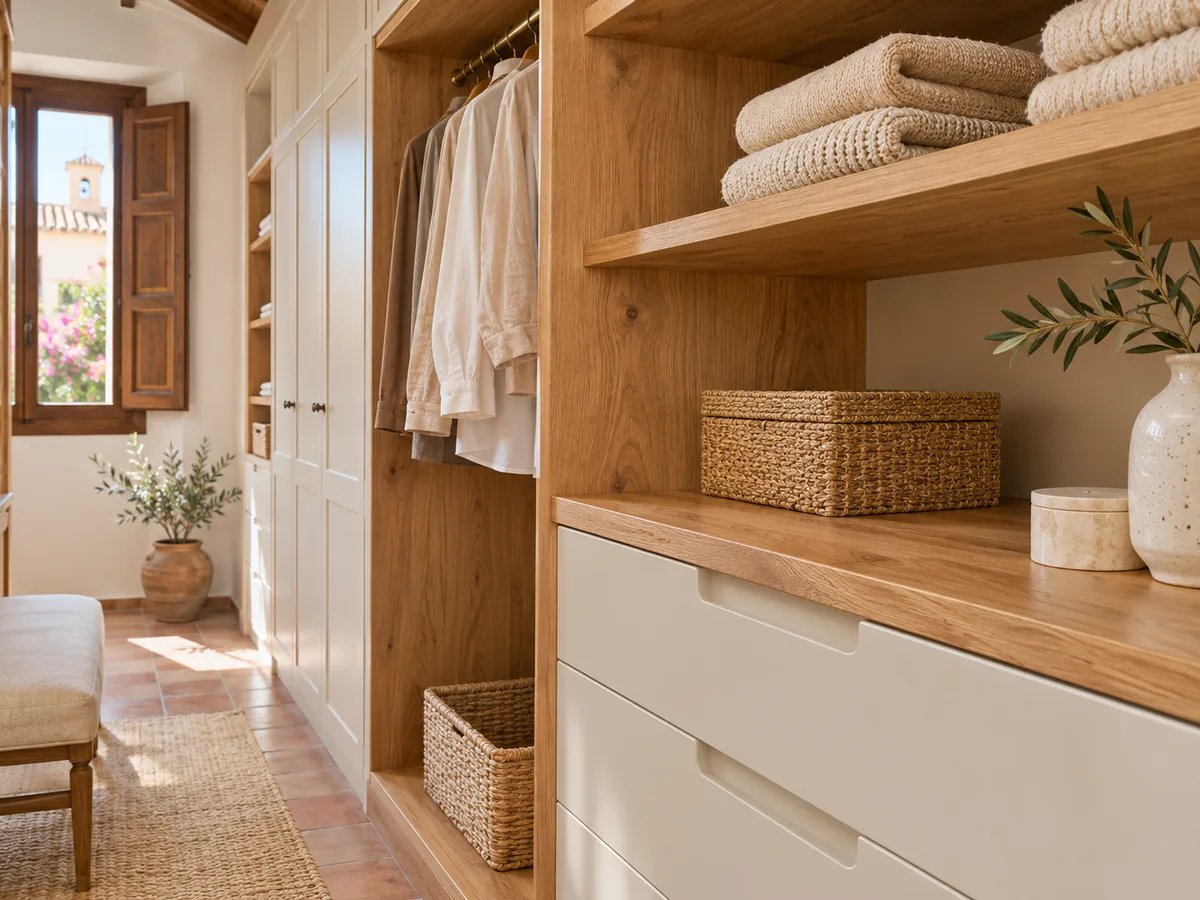
Ask us to come and measure up in Baena
- 01You leave us your name and your area.
- 02We message you on WhatsApp to agree a day.
- 03The measuring visit costs €50 and is free if you place an order.
How the material affects your quote in Baena
In a wooden walk-in wardrobe, the material counts towards the cost, but not as much as the visible surface area. Natural veneer costs more than decorative board, and solid wood more than both. But if only the main doors are veneer or solid wood, the overall difference is moderate.
Other factors that move the price are the number of drawers, the hardware and the dimensions. When the budget is tight, the smartest approach is usually to invest in what you see and touch, and save on the internal structure.
From Baena you can enter your measurements and material preferences in the configurator. The team will give you a price guide within 24 hours, the measuring visit costs €50 if you don't go ahead and is free if you do, and manufacture takes 2 to 3 weeks on average.
Wood and style: from contemporary to rustic
- 01
Style doesn't come from the type of wood alone. With straight lines, plain doors and understated tones, a wooden walk-in wardrobe feels contemporary; with frames, pronounced grain and warm tones, it leans towards rustic. It is the design, not the material, that decides.
- 02
If your home in Baena has a defined character, for example exposed beams or classic joinery, the choice more or less makes itself. If not, you can go for a middle ground with an oak with a calm grain.
- 03
To find out more, we have pages dedicated to modern wooden walk-in wardrobes and rustic wooden walk-in wardrobes, explaining how to work with each style.
Enquiry
Tell us about your project in Baena
- 1We read your message and look at your photos.
- 2We reply on WhatsApp with a first figure.
- 3We measure up and prepare the final quote. The measuring visit costs €50 if you don't go ahead with the order and is free if you do.
We don't cut a single board until you've approved the design and the price.
Questions
Frequently asked questions about wardrobes in Baena
After installation: warranty and care for your wardrobe.
Which parts of the walk-in wardrobe should be made in natural wood?
The drawer fronts, doors and most visible shelves, because those are the elements you look at and touch. The internal structure and backs are better done in stable board.
How can I tell natural veneer from a wood-effect finish?
Look at the grain: in natural veneer the pattern never repeats and varies slightly from piece to piece; in a wood effect the pattern repeats regularly. A physical sample makes it clear in a few seconds.
Can I use two or three materials in the same walk-in wardrobe?
Yes, and it usually gives a better result than a single material. Combining veneer on the doors with decorative board inside looks good and keeps costs under control. The key is that the tones go well together.
Is solid wood or veneer better for a walk-in wardrobe?
For small, visible pieces, solid wood looks great and can be refinished. For large surfaces, veneer is usually more stable and lighter. It depends on where each one is going.
When is the exact tone of my walk-in wardrobe settled?
Before manufacture, with a physical sample checked in your home. The finish reference is noted in the project so that what is produced matches what you chose.
Shall we talk about your project?
Send us a photo of the space and some approximate measurements on WhatsApp: we'll give you some initial guidance and arrange the measuring visit.