Made-to-measure shallow wardrobes in Baena
A shallow wardrobe turns a space that is too tight for conventional furniture into useful storage: a hallway, a corner of the entrance, the side of a bedroom. In Baena we design them with very little depth, but with the usable depth carefully measured, so the doors open without blocking the way and every shelf holds what it should. Here are the key points to plan before you send us your configuration.
Shape your next wardrobe.
Try out the measurements, plan the interior layout and choose your finishes. See your idea take shape and share it with us so we can prepare your quote.
Send us your configuration with your measurements and we'll give you a guide price within 24 hours, free of charge. The measuring visit at your home comes afterwards.
Overall depth and usable depth: what changes in your wardrobe
The total depth is the distance from the wall to the front of the unit. The usable depth is what is actually left inside once you deduct the thickness of the back panel, the doors and the fittings. In a shallow wardrobe that difference matters a lot: a unit with a total depth of 40 cm may leave only about 34 or 35 cm of usable space.
That is why it pays to measure twice with a tape measure, once at floor level and once at chest height, in case the wall is not quite straight. With those figures you can decide what goes inside: with limited depth, shelves suit folded clothes, shoes or boxes, while hanging clothes need a different solution, as we explain below.
What you can store when the space has little depth
A shallow space is not a useless space. With 30 or 35 cm you can store books, folded clothes, towels, cleaning products, box files, shoes or toys. With 40 to 45 cm you can fit sheets, thin blankets and bulkier items.
What won't fit is anything that needs hanger width: coats, jackets and dresses hung face-on. If those clothes are your priority, we can design a rotating rail or a side-opening rail, or give one section of the wardrobe more depth for hanging and spread the rest across shallow shelves. Before ordering, make a pile of what you want to store and measure its real height and width.
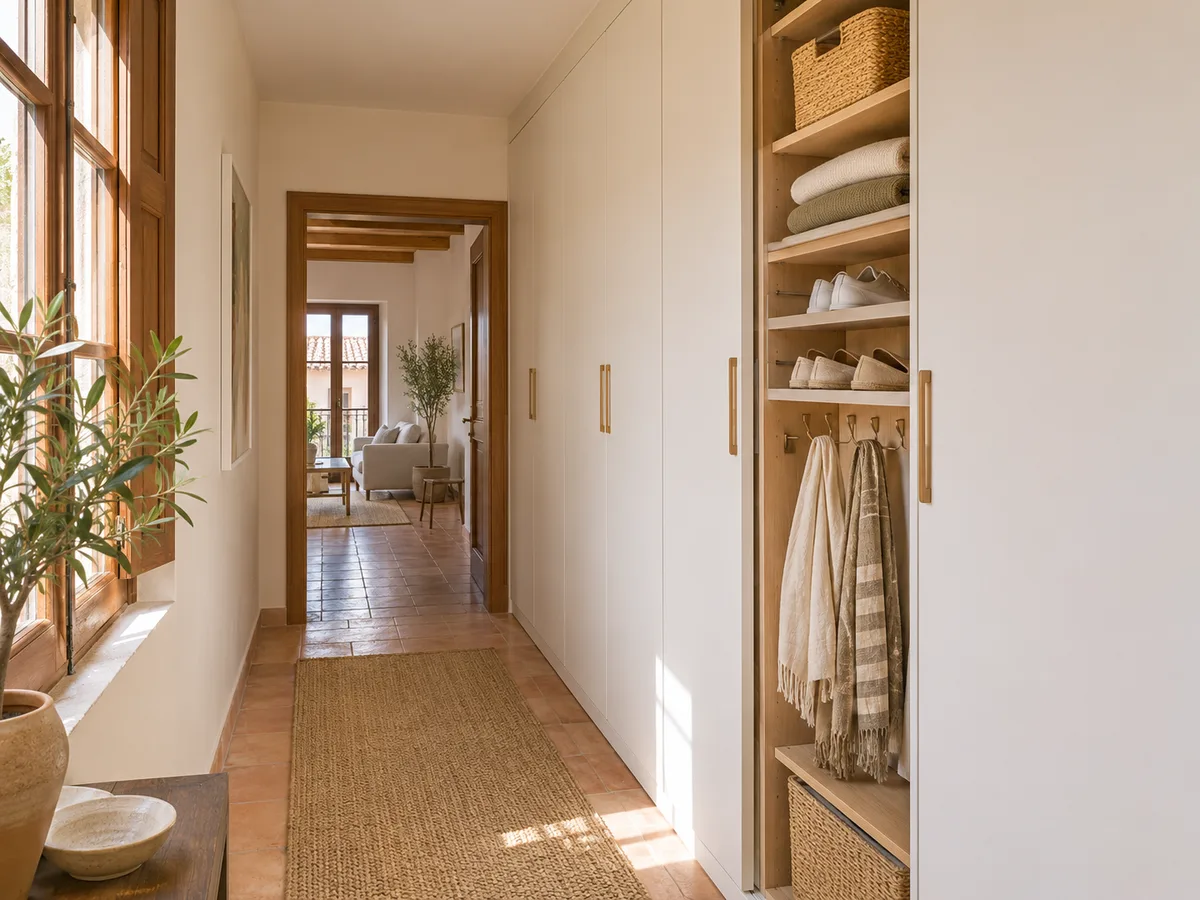
Shelves, shoe rack and front-mounted hooks
The interior of narrow wardrobes is solved with adjustable shelves, pull-out trays and angled shoe racks. A shelf every 25 or 30 cm works for folded clothes, while a shallow shoe rack places shoes diagonally, in rows of pairs, so they don't take up the whole width of the shelf.
Front-facing hanging rails are a useful trick: a fold-out rail that pulls out sideways, fitted at the edge of the door, lets you hang garments parallel to the front rather than side-on. That way you can store hanging clothes even when the depth is under 50 cm. These accessories are chosen according to weight and use: a rail for light shirts is not the same as one for coats.
Have you already measured the space?
Send us a photo and the approximate measurements on WhatsApp and we'll give you some initial guidance.
Doors that respect walkways and nearby furniture
- 01
When the wardrobe is in a hallway, the way the doors move matters as much as the depth itself. Narrow hinged doors take up floor space when they open, and in a Baena hallway of little more than a metre they can block anyone trying to pass. Sliding doors don't intrude into the walkway, although they only let you open part of the front.
- 02
Between the two there are intermediate options: narrow leaves that swing back 180 degrees and sit flat against the side, or bifold doors that reduce the projection. The choice is made with the plan in front of you: you draw the arc of each door or the run of the track and check it against the room door, a radiator or a switch. Sliding doors aren't always suitable: if the wardrobe is very deep, the track needs a minimum amount of space that you may not have.
How we deal with skirting boards, pillars and uneven walls
In narrow spaces you often find obstacles that take away a few precious centimetres: a tall skirting board, a pillar, an exposed pipe or a wall that is not plumb. Each one reduces the usable depth at a different point, and it has to be accounted for so the wardrobe sits level with no gaps.
For the skirting board, the module is set back or the back panel is cut away so the unit sits flush against the wall. If there is a pillar, we design a narrower module or run a continuous front across it. When the wall is uneven, trims or scribing profiles are added to cover the difference. Everything is worked out at the design stage, which is why a detailed photo of each obstacle, with a tape measure beside it, is worth more than any description.
Latest work by SI, ARMARIO
@si.armario
Made-to-measure wardrobes and walk-in wardrobes
Latest posts
Where a shallow wardrobe works best
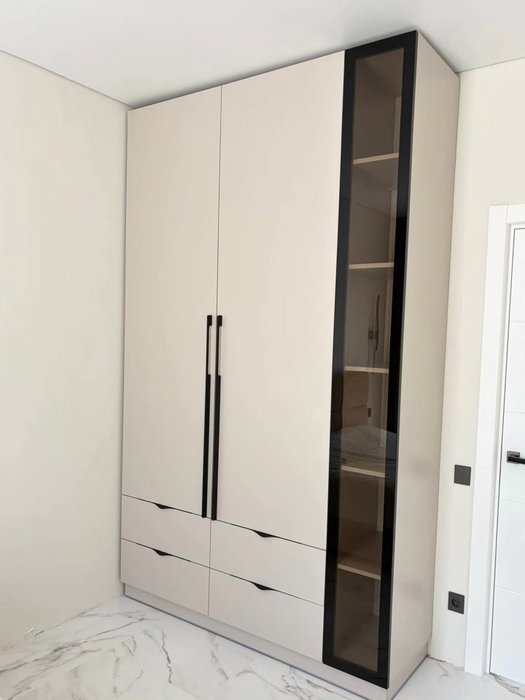
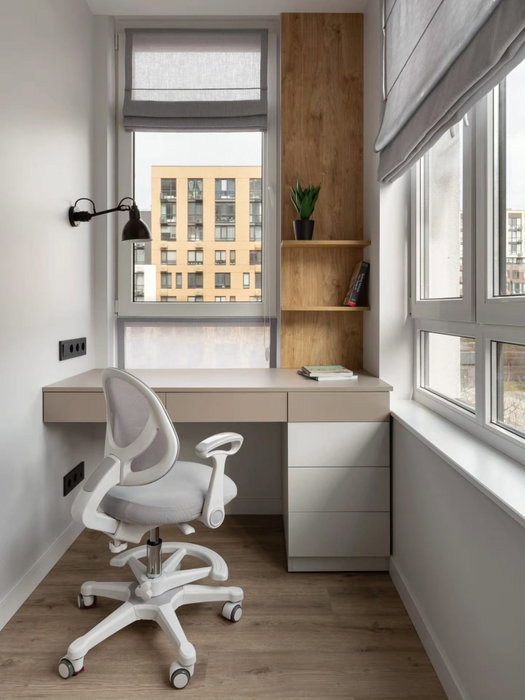
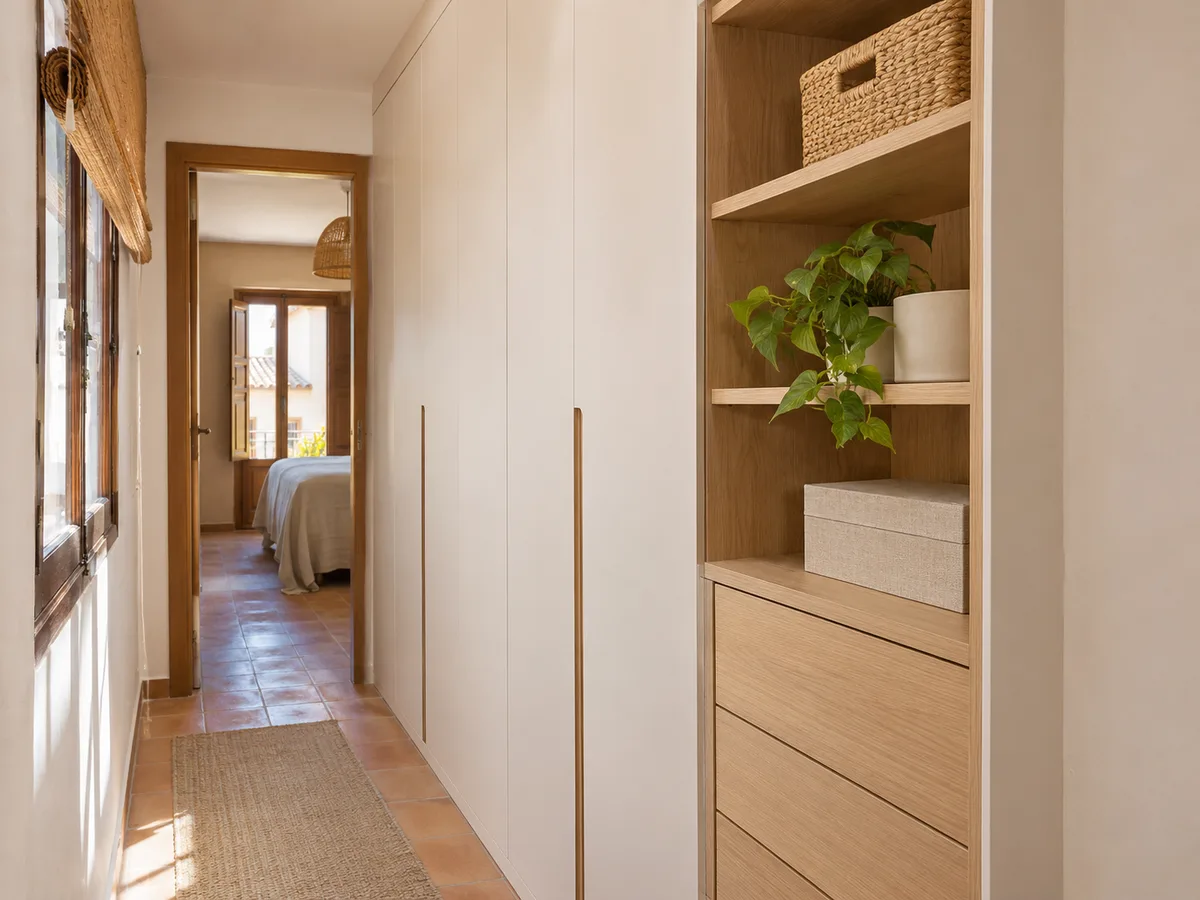
Shallow wardrobes work well in four places in the home. In the entrance, as a shoe rack and a place for keys, bags and umbrellas. In a long hallway, making use of a blank wall to store linen and boxes. In the utility room or gallery, with cleaning products and tools close to hand. And in a narrow bedroom, as a complement to the main wardrobe.
In many homes in Baena, with patios, galleries or long hallways inherited from older houses, this kind of space comes up often and stays empty for lack of a piece of furniture that fits. A shallow wardrobe designed to the exact size of the wall turns it into real storage, with doors, shelves and height planned for what you are going to keep there.
Ask us to come and measure up in Baena
- 01You leave us your name and your area.
- 02We message you on WhatsApp to agree a day.
- 03The measuring visit costs €50 and is free if you place an order.
What measurements and photos to send so we can study the space
To assess a shallow wardrobe in Baena we need the width, height and depth of the space at several points, the position of sockets, switches and radiators, and the distance to the door or the opposite wall. If it is a hallway, also note the clear width you want to keep for getting through.
Add three photos: a front-on shot of the whole space, a side-on one that shows the depth, and another of any problem details. With that information you can go into the configurator, choose the doors and modules and send us your design. If any information is missing, the team will ask you for it before going further; a price guide comes back within 24 hours.
Finishes, quote and final check in Baena
- 01
In narrow spaces it is best to choose light, smooth finishes, because they make the space feel wider: white, sand tones or soft grey. A mirrored front on one of the doors reflects the light in the hallway and eases the cramped feeling, although it adds weight to the door.
- 02
The quote depends on the number of modules, the doors, the finish and the interior accessories. It is confirmed after the measuring visit, which costs €50 if you don't go ahead and is free if you order the wardrobe. Once the design is approved, manufacturing takes around 2–3 weeks, and before installation we check that the depth, height and doors match what was drawn.
Enquiry
Tell us about your project in Baena
- 1We read your message and look at your photos.
- 2We reply on WhatsApp with a first figure.
- 3We measure up and prepare the final quote. The measuring visit costs €50 if you don't go ahead with the order and is free if you do.
We don't cut a single board until you've approved the design and the price.
Questions
Frequently asked questions about wardrobes in Baena
After installation: warranty and care for your wardrobe.
What can I store in a space only 40 cm deep?
Quite a lot. With a total depth of 40 cm you get about 35 cm of usable depth, enough for shelves with folded clothes, shoes and boxes. For hanging clothes, we use side-hanging rails or a rail turned to face the front.
What if I need to hang shirts and jackets?
A standard hanger needs about 50 cm of depth, so in a shallow wardrobe we have to use fold-out or turned rails. The clothes hang sideways and slide out so you can choose; it's less convenient than in a standard wardrobe, but it solves the problem.
Do sliding doors always solve a narrow space?
No. Although they don't intrude into the walkway, they take away some depth because of the double tracks and only let you open one part at a time. In very narrow spaces, a short hinged door or a bifold door usually works better.
How much hallway width should I leave clear when installing a wardrobe?
With a depth of 30 to 35 cm you keep comfortable passage in most hallways. The important thing is to leave at least 80 cm clear once the doors are closed, and to check how far the doors swing.
Can narrow wardrobes go all the way up to the ceiling?
Yes, and it's the recommended approach: gaining height makes up for the lack of depth. A top cupboard goes in the upper part for things you rarely use, and the easy-to-reach part stays free for everyday items.
How do I order a shallow wardrobe for a wall with a radiator?
We measure the distance from the radiator to the wall and leave a ventilation gap. The module is narrowed or cut back in that area, and the rest keeps the same shallow depth. A sketch with the radiator marked is enough for us to work it out.
Shall we talk about your project?
Send us a photo of the space and some approximate measurements on WhatsApp: we'll give you some initial guidance and arrange the measuring visit.